Showing posts with label van gogh. Show all posts

Monday, October 15, 2012

Van Gogh "Mini" Post


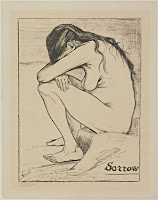
While I was researching my last post on van Gogh’s Crabs, I came across some information on another work I felt like sharing. It’s called Sorrow and was done in 1882. After reading a bit about it, I found it really is quite sorrowful.

There are a number of different versions of Sorrow. My favorite is the chalk drawing in the New Art Gallery Walsall in the UK. Its lines are more angular, and it has an even stronger graphic quality than the lithographs. Plus I love the detailed setting. You can certainly see van Gogh’s interest in Japanese prints.
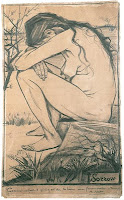
Chalk, 44.5 x 7 cm.
Lithograph, 46.7 x 37.1 cm.
Pencil and wash, 46.7 x 30.2 cm.


Anyway, I found myself admiring the woman's stomach rolls. They make the piece seem so grounded and down to earth. At the same time though, the title and subject of the piece made me think the woman was more or less destitute, and as stereotype tells us, all poor people back in the day were nothing but skin and bones. So I figured that maybe she was pregnant.

It turns out she was. Her name was Clasina Maria Hoornik and she was 32 years old. When van Gogh came across her wandering the streets of the Hague with her 5-year-old daughter in January 1882, she had been abandoned by her unborn baby’s father, was working as a seamstress and a prostitute, smoked cigars, and drank too much. Van Gogh called her “Sien” and took her into his home. In exchange, she became his model.

In July, Sien gave birth to a son and named him Willem, which, incidentally, is van Gogh's middle name. Van Gogh loved Sien and his new family. In a letter to his brother Theo, he even talked about marriage. But the couple had a hard life. Because of their relationship, van Gogh became estranged from nearly all of his family and friends. On top of that, the little household was extremely poor, Sien was typically sick, and at the time Willem was born, van Gogh was recovering from the clap (which he probably got from Sien). By 1883, Sien had gone back to prostitution and drinking.

In the fall, van Gogh left Sien and the only domestic relationship he would ever have. Sien’s life continued to be unstable. While she married a man in 1901 to to legitimize her children, she had given them up to their grandmother and uncle. In 1904, she drowned herself in the Schelde River.

Cheery.

Saturday, October 13, 2012

Vincent's Crabs

Let’s start out easy, with an artist almost everyone is familiar with:

Vincent van Gogh

While I could have chosen this . . . or this . . .


or this, or this, or this . . .


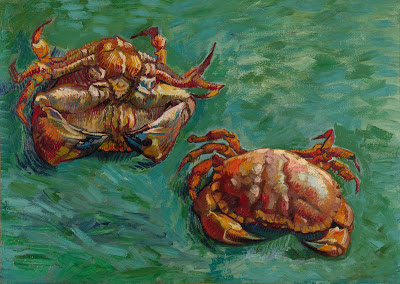
I chose Two Crabs, a relatively little known work most scholars think was painted in 1889.

Two Crabs, 1889, oil on canvas, 47 x 61cm.

I first saw Two Crabs while in London visiting the National Gallery in 2007. While it was a small piece surrounded by legendary Post-Impressionist paintings, its intense color and careful sense of modeling pulled me in. I spent the rest of my visit lurking behind a group of toddlers who had plopped themselves down in front of the object of my desire.

Since then, I’ve done some research into the history of the painting and have come to have a deeper appreciation of the insights it offers into van Gogh’s life and emotional state. While some scholars, perhaps correctly, believe van Gogh painted Two Crabs between 1887 and 1888, I’m going to stick with the 1889 date because it makes for a better story. Plus, there are letters and possible Japanese influences that suggest 1889 anyway.

But to get to Two Crabs’s significance, we need to back up a little first. Van Gogh had spent the last months of 1888 living and working with fellow Post-Impressionist artist Paul Gauguin. He had hopes of founding a utopian artists’ collective, but his health and relationship with Gauguin quickly deteriorated. In December, he was taken to the Arles hospital after what I will only refer to as “the Ear Incident.” (“The Ear Incident” is a whole ‘nother story, shrouded in legend. I’ll leave you to look it up on your own.)

We think van Gogh painted Two Crabs right after his release from this hospital. He’d gone through a traumatic experience, but, as he explained in a letter to his brother Theo, he was ready to “get back into the habit of painting.”

It’s this transition period that Two Crabs captures so well. Its composition is made up of vibrant hatching brushstrokes that fancy-shmancy art history people call “taches.” The crabs’ crisp edges and van Gogh’s juxtaposition of complementary colors make it seem like the scene could move. The green, sea-like background undulates while the upper crab flails its legs. With the ground tipped almost vertically, the crabs look like they could tumble out of the painting at any second. Whether intentional or not, van Gogh was in effect illustrating his own tumultuous and uncertain situation at the time.

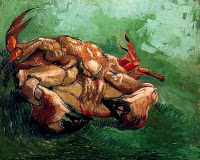
Crab on its Back, 1888, oil on canvas, 38 x 46.5cm.

That a similar painting exists showing only one crab suggests that van Gogh may have painted the crabs in Two Crabs from the same model. With this in mind, the painting's message could be hope for the future. On top, the crab, like van Gogh, struggles to get on its feet again. On the bottom, it has recovered itself, overcoming its recent crisis.