Showing posts with label Halloween. Show all posts

Sunday, October 27, 2013

Faléro's Foreshadowing

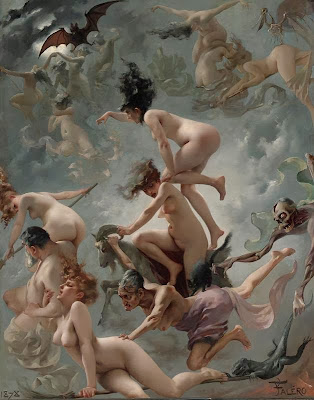
I like Halloween. It’s my favorite holiday. I find spooky things empowering and just plain fun. But what artist should I focus on for a Halloween themed post? Hieronymus Bosch intimidates me. My favorite Ensor doesn’t have a single skeleton or masked figure. I’ve already done Munch’s The Scream. Nothing seemed quite right. Until I came across Luis Ricardo Faléro’s 1878 oil painting Departure of the Witches.

Luis Ricardo Faléro, Departure of the Witches, 1878, oil on canvas, 145.5 x 118.2 cm.

Luis Faléro is interesting on his own. Born in Spain in 1851, he was a precocious child. He studied in London when he was young and eventually settled there in 1887. But first, he ran away from a career in the Spanish Navy when he was only 16 years old. On foot. To Paris. Paying his way by doing crayon portraits. In Paris, he studied chemistry, engineering, and art, but abandoned the first two because they were too dangerous. Oh, and he also took up astronomy.

Some sources say Faléro was the Duke of Labranzano, but in any case, he was rich. With a pointed beard and black hair, he looked like he stepped out of a Velázquez painting. His compatriots called him Don Luis. In 1896, Maud Harvey sued him for paternity. She claimed that he seduced her when she was his 17-year-old housemaid and artist’s model. He fired her after he discovered she was pregnant. Although she was awarded 5 shillings per week, the suit may not have done her much good. Faléro died in December that same year.

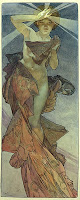
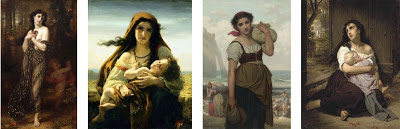
In reality, I don’t like much of Faléro’s art. He specialized in female nudes in allegorical settings. And while many of them are interesting as precursors to the work of art nouveau artist Alfons Mucha, they’re all incredibly syrupy. Like soft-focus Barbie dolls with no naughty-bits. He’s basically a more ethereal Bouguereau.

Right: William-Adolphe Bouguereau, Night, 1883, oil on canvas, 208.3 x 107.4 cm
Center: Luis Ricardo Faléro, Twin Stars, 1881, watercolor on paper, 41.9 x 21.6 cm.
Left: Alfons Mucha, Study for The Morning Star, 1902, ink and watercolor on paper, 56 x 21 cm.

But Departure of the Witches is different. It still has a pin-up girl aesthetic, but it also has grit, energy, and a little humor (did you see the skeleton’s mustache?!). And while the pattern-like groups of activity remind me of Dutch and Flemish art, Departure looks like it could have been painted yesterday. You know, by someone who really likes late 19th century academic art.

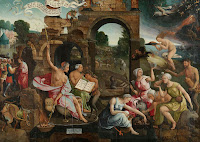
Right: Gil Elvgren, Riding High, 1958, oil on canvas, 76.2 x 61 cm.
Left: Jacob Cornelisz van Oostsanen, Saul and the Witch of Endor, 1526, oil on panel, 85.5 x 122.8cm.

In reality, Departure of the Witches probably depicts a scene from the German legend of Faust in which a successful scholar makes a pact with the devil in exchange for unlimited knowledge and worldly pleasure. Johann Wolfgang von Goethe’s version of the legend was popular in theatres of the time, and Faléro is known to have painted at least one other depiction of the story. In fact, Sotheby’s mistakenly titled the painting Faust’s Vision in a 2003 auction and said that it had been exhibited in the Paris Salon of 1880. Oddly enough, the real Faust’s Vision was in the same auction mistakenly titled Faléro’s Dream.
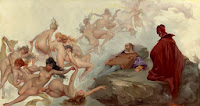
Luis Ricardo Faléro, Faust’s Vision, 1880, oil on canvas, 81.2 x 150.5 cm.
 

Anyway, in Goethe’s play, the demon Mephistopheles represents the devil and leads Faust on a quest for ultimate bliss. With his help, Faust seduces Gretchen, a girl who becomes pregnant with his illegitimate child. To distract Faust from his situation, Mephistopheles gives him a dream of Walpurgis Night, a spring festival exactly 6 months before All Hallows' Eve when witches gather for their annual Sabbath in the German mountains. The dream lasts months, and Faust wakes to find that Gretchen has given birth, drowned the baby, and is sentenced to death.

So there you have it. Departure of the Witches depicts a fever dream of hellish debauchery. Maybe the lone man in the painting is Faust. Or maybe the painting hints at Faléro’s own scandalous future. Maybe the man is the artist himself.


Saturday, October 27, 2012

Oh no! Computer issues!

My laptop is out of commission for a few days. Please accept this Dalí as a consolation.

Salvador Dalí, Freud's Perverse Polymorph (Bulgarian Child Eating a Rat), 1939
© 2012 Salvador Dalí, Fundació Gala-Salvador Dalí,  Artists Rights Society (ARS), New York

A full post on Salvador Dalí will be up in the next day or four!

(Happy Halloween!)

Saturday, October 20, 2012

Merle's Logs

I’m going to a Halloween party tonight, and in honor of the spooky season, I chose a spooky work of art. 

Hugues Merle, Une Folle (The Lunatic of Étretat), 1871, oil on canvas, 152.7 x 99.4 cm.

Actually, it’s several works of art. On the advice of his dealers, the artist Hugues Merle often did smaller versions, or “reductions,” of his paintings to sell commercially. I’m showing you the Chrysler Museum’s version because it has the best photograph and is most likely the original. There’s also a reduction (92.7 x 67.3 cm) at the Arnot Art Museum in Elmira, New York, and two other paintings that have four kids standing around gawking. I don’t like the version with the kids as much. The woman’s hair is too flat, and Merle replaced the forest clearing with an amorphous mass of green and blue. Most of all, I miss the sense of isolation.

Not as good.

I’ve only seen Une Folle in person at the Arnot Art Museum. Although their version is smaller, it’s almost identical to the Chrysler’s in every other way. Except the name. I’m using Une Folle as an overarching title, but all of the paintings were known by several different names in the past and still go by different names now. The Chrysler calls their version The Lunatic of Étretat while Arnot just calls theirs The Lunatic. Other titles include La Folle, Pauvre Folle, Carmella, Pauvre Folle, Lunatique à Étretat, Poor Fool, Carmella, Poor Fool, A Crazy Woman, and A Mad Woman. It’s super confusing.

Anyway, Hugues Merle is an example of what today’s art historians sneeringly refer to as “Academic" artists. He studied at the École des Beaux-Arts under Léon Cogniet (whose painting Scène du Massacre des Innocents was a huge influence), and was honored at the official Paris Salon on multiple occasions. He even exhibited Une Folle (most likely the large Chrysler version) at the Salon of 1873. Although Merle often painted sentimental mother/child scenes, he was also known for his depictions of the downtrodden.

Now, Merle’s been almost completely forgotten, overshadowed by his rival William-Adolphe Bouguereau. I feel for Merle. If the dealer Paul Durand-Ruel hadn’t introduced the two artists and suggested Bouguereau paint more like Merle, Bouguereau may not have been remembered at all. I, for one, don’t think any of Bouguereau’s works manage to capture Merle’s level of emotional desolation. I’ll talk about the one that comes closest in a later post.

Back to why I like Une Folle. It’s weird. The woman has a bonnet-wearing log all wrapped up nice and cozy in a blanket! She’s like the log lady from Twin Peaks, but better.

The Log Lady from Twin Peaks

Beyond that though, she looks so powerful. The way she clutches the log to her chest and stares out at the viewer with those big, shadowy eyes makes it look like she’s daring us to challenge her. And the Classic pose reveals dignity amidst delusion. It reminds me of that windy, dark, eerily lit moment just before a storm. It makes me feel giddy and energized. Like I should jump into the air and fly around on a broomstick.

I tried doing some research into the subject matter, but I hit a dead end. I want to know who the woman is and what happened to her to make her the way she is. Since some of the titles refer to her as Carmella, I thought maybe it had something to do with the J. Sheridan Le Fanu novella. But no.  It turns out that's just a vampire story. No logs.

I’m also curious to know who the model is. Either Merle makes all women look the same, or he painted her over and over.

Who is she?!